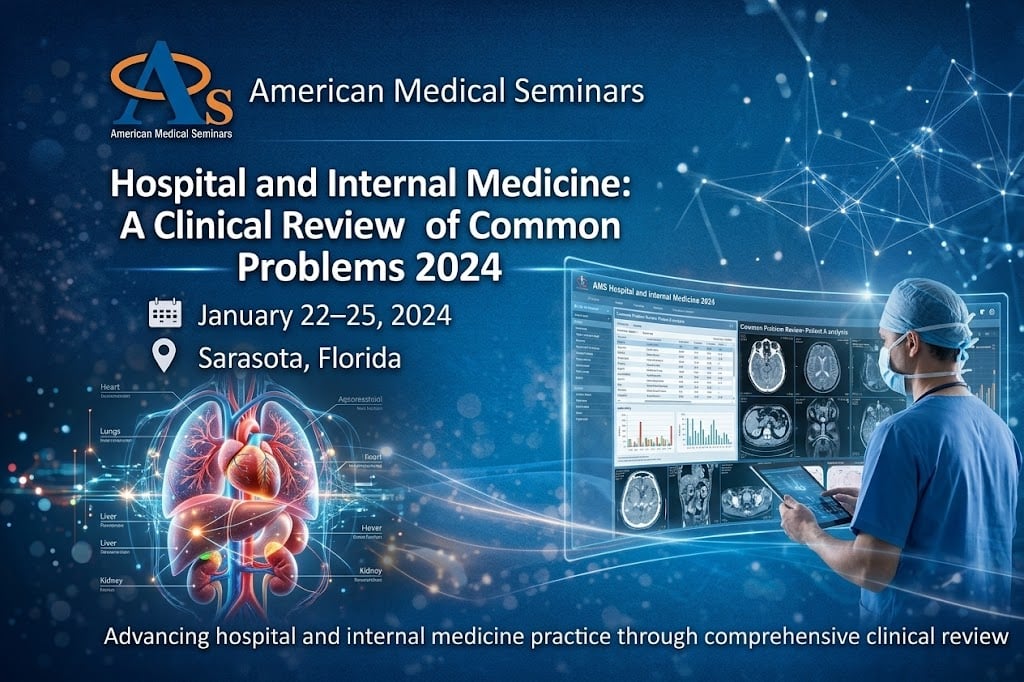
AMS Hospital and Internal Medicine A Clinical Review of Common Problems 2024
+ Target Audience: hospitalists, internists, family physicians, and allied healthcare providers
+ Information:
2024 Hospital and Internal Medicine: A Clinical Review of Common Problems – Fours Day
Faculty: Kendal Williams, M.D., M.P.H..; Lawrence H. Brent, M.D.
Release Date: January 22–25, 2024
The
American Medical Seminars – Hospital and Internal Medicine: A Clinical Review of Common Problems 2024 is best for hospitalists, internists, family physicians, and allied healthcare providers who want a concise, update on common inpatient and internal medicine problems. It is particularly valuable for clinicians managing hospitalized patients and those seeking practical, evidence‑based refreshers on everyday conditions.
Who Should Attend
- Hospitalists & internists managing acute and chronic conditions in inpatient settings.
- Family physicians & general practitioners who encounter internal medicine problems in outpatient care.
- Residents & fellows in internal medicine or family medicine seeking structured review.
- Advanced practice providers (NPs, PAs) working in hospital or primary care environments.
- Allied health professionals interested in expanding knowledge of common medical problems.
What You’ll Learn
The 4‑day program (January 22–25, 2024, Sarasota, Florida) covered:
- Pulmonary medicine: COPD and asthma management in hospitalized patients.
- Infectious disease: inpatient management of skin and soft tissue infections.
- Rheumatology: rheumatoid arthritis, osteoarthritis, systemic lupus erythematosus, scleroderma, Raynaud’s disease, idiopathic inflammatory myopathies, spondyloarthropathies.
- Practical updates: diagnostic strategies, treatment protocols, and case‑based learning.
Day 1
Update on the Management of COPD and Asthma in the Hospitalized Patient
Attendees of this presentation should be able to:
- Perform initial management and stabilization of the patient with asthma or COPD exacerbation and distinguish between the strategies for each condition.
- Develop an evidence-based strategy for the management of COPD based on the GOLD criteria.
- Prescribe an effective therapeutic strategy for asthma, taking into account recent studies on the safety and effectiveness of various agents.
- Detect conditions that may mimic asthma or COPD in the clinical setting.
Overview of the Inpatient Management of Skin and Soft Tissue Infections
Attendees of this presentation should be able to:
- Review the clinical presentation and categorization of common skin and soft tissue infections.
- Differentiate common non-infectious conditions that can mimic skin and soft tissue infections.
- Based on evidence from the CDC and standard of care publications, recognize and incorporate the changing epidemiology and resistance patterns impacting skin and soft tissue infections into therapeutic plans.
- Recognize the types of drug-associated rashes and formulate an effective treatment plan for each.
Rheumatoid Arthritis
Attendees of this presentation should be able to:
• Demonstrate the role of genetics, environmental factors, immune cells, and proinflammatory cytokines in the pathogenesis of rheumatoid arthritis.
• Illustrate the clinical features, extra-articular manifestations, and complications of rheumatoid arthritis.
• Utilize and compare various methods of measuring disease activity in rheumatoid arthritis.
• Compare and contrast the mechanisms of action of current and emerging therapies for RA and prescribe treatment for patients with rheumatoid arthritis according to ACR guidelines
Osteoarthritis
Attendees of this presentation should be able to:
- • Employ the history and physical exam to make an accurate diagnosis of osteoarthritis
- • Differentiate osteoarthritis (structural) from rheumatoid arthritis (inflammatory)
- • Recommend and prescribe non-pharmacologic and pharmacologic therapies for patients with osteoarthritis according the ACR recommendations
Systemic Lupus Erythematosus
Attendees of this presentation should be able to:
- • Evaluate the varied clinical presentations and manifestations in the course of systemic lupus erythematosus.
- • Order and interpret laboratory testing used in the diagnosis of systemic lupus erythematosus in accordance with ACR Guidelines.
- • Monitor and employ treatment options for patients with systemic lupus erythematosus according to EULAR recommendations and evidenced based studies.
Day 2
Scleroderma and Raynaud’s Disease
Attendees of this presentation should be able to:
- Specify the clinical manifestations of scleroderma.
- Apply the ACR/EULAR classification criteria for systemic sclerosis.
- Utilize treatment available for the manifestations of scleroderma as per the current EULAR recommendations.
- Apply an appropriate diagnostic work-up and treatment of Raynaud’s phenomenon.
Idiopathic Inflammatory Myopathies
Attendees of this presentation should be able to:
- Diagnose idiopathic inflammatory myopathies and differentiate between inflammatory and other types of myopathies
- Evaluate patients with drug induced myopathies and other causes of elevated CPK
- Recommend treatment of idiopathic inflammatory myopathies and measure disease activity
Spondyloarthropathies
Attendees of this presentation should be able to:
- Distinguish the clinical features of the different spondyloarthropathies to improve diagnostic accuracy.
- Utilize clinical features, laboratory studies, and radiological studies to make a diagnosis of axial spondyloarthropathy.
- Prescribe pharmacologic agents according to ACR and EULAR recommendations and evidence-based results from clinical trials for patients with spondyloarthropathies.
Update on the Evaluation of Chest Pain
Attendees of this presentation will be able to:
- Based on recent standard of care publications, review the contribution of history, physical exam, and EKG findings to the evaluation of chest pain.
- Distinguish ischemic EKG changes from their common mimics.
- Apply the use of novel and standard cardiac biomarkers to the diagnosis of ACS.
- Based on the guidance from the ACC/AHAS and recent significant research studies, determine the best evaluation strategy for the individual chest pain patient.
Update on the Management of Acute Coronary Syndromes
Attendees of this presentation will be able to:
- Distinguish the forms of ACS and their relative prognoses.
- Based on the most recent AHA/ACC guidelines, apply the appropriate initial management of patients experiencing acute coronary syndromes.
- Based on the most recent AHA/ACC guidelines, categorize the therapeutic options for patients with unstable angina and post-MI.
- Based on the most recent AHA/ACC guidelines, employ the secondary prevention strategies for
- patients who have experienced an acute coronary syndrome.
Day 3
Update on the Management of Congestive Heart Failure in the Hospitalized Patient
Attendees of this presentation should be able to:
- Understand and compare the vaccines
- Understand the recommendations for isolation after exposure and after illness
- Understand the status of diagnostic tests and treatments
Update in Inpatient Renal Medicine
- Attendees of this presentation should be able to:
- Review the evaluation of acute renal failure in the inpatient setting.
- Discuss the forms of dialysis used in hospitalized patients.
- Review the management of hyperkalemia.
- Discuss the management of fluid overload in patients with advanced kidney disease.
- Review best practice strategies for the use of diuretics in hospitalized patient
Update in GI Inpatient Medicine
Attendees of this presentation will be able to:
- Evaluate and manage both upper and lower gastrointestinal bleeding according to the current standard of care.
- Manage common intestinal complications like small bowel obstruction and both minor and major constipation syndromes.
- Manage common gallbladder syndromes as well as acute pancreatitis.
- Evaluate and manage both appendicitis and diverticulitis.
- Assess and strategize the common intestinal emergencies of bowel perforation and ischemia syndromes.
Septic Arthritis
Attendees of this presentation will be able to:
- Determine the risk factors associated with septic arthritis.
- Utilize the British Society of Rheumatology Guidelines for management of the hot swollen joint in adults to differentiate septic arthritis from other causes of acute monoarticular
- Utilize epidemiological and clinical clues to determine bacterial etiology in patients with septic arthritis.
Rheumatology Procedures
Attendees of this presentation should be able to:
- Use techniques for appropriate indications for intra-articular and soft tissue injections in rheumatology
- Employ appropriate pharmacologic and non-pharmacologic therapies including injections for painful joints as per the ACR recommendations.
Day 4
Crystal Arthropathies
Attendees of this presentation will be able to:
- Distinguish the clinical presentations and manifestations of gout and associated medical comorbidities
- Prescribe treatment for patients with gout according to the EULAR and ACR recommendations and guidelines
- Distinguish the clinical presentations, manifestations, and treatment of calcium pyrophosphate deposition disease (CPPD) and pseudogout
Vasculitis
Attendees of this presentation should be able to:
- Utilize the classification of vasculitis.
- Specify the diagnosis of specific vasculitides based on clinical, laboratory, and pathologic features.
- Prescribe treatment for patients with vasculitis based on their diagnosis.
Update on the Management of Stroke and Transient Ischemic Attack
Attendees of this presentation should be able to:
- Assess common presentations of cerebrovascular insufficiency.
- Prescribe the initial management of patients with a suspected acute CVA.
- Apply cutting edge strategies and therapies for the management of hemorrhagic and thrombotic strokes.
- Distinguish between stroke and TIA and appropriately assess the patient with TIA for early risk of stroke.
- Formulate an effective post-stroke secondary prevention plan as per the AHA/ASA guidelines.
The Evaluation and Management of Syncope and Vertigo
Attendees of this presentation should be able to:
- Appropriately evaluate patients with syncope or vertigo.
- Formulate a diagnostic evaluation strategy of syncope or vertigo that is based on best practices and the 2017 ACC/AHA/HRS guidelines.
- Debate the value of the various diagnostic approaches to the workup of syncope.
- Prescribe an effective therapeutic strategy for the management of both syncope and vertigo per the 2017 ACC/AHA/HRS guidelines.
Delirium, Dementia, & Psychosis – The Diagnosis & Mgmt of the Inpatient with Mental Status Change
Attendees of this presentation should be able to:
- Apply a diagnostic approach to the hospitalized patient with acute mental status change.
- Discuss the differential diagnosis of psychosis in the hospitalized patient.
- Based on a systematic review of the best evidence, formulate an evidence-based management strategy for delirium in the hospital setting.
- Develop an evidence-based screening and treatment protocol for the prevention and management of alcohol withdrawal syndromes.