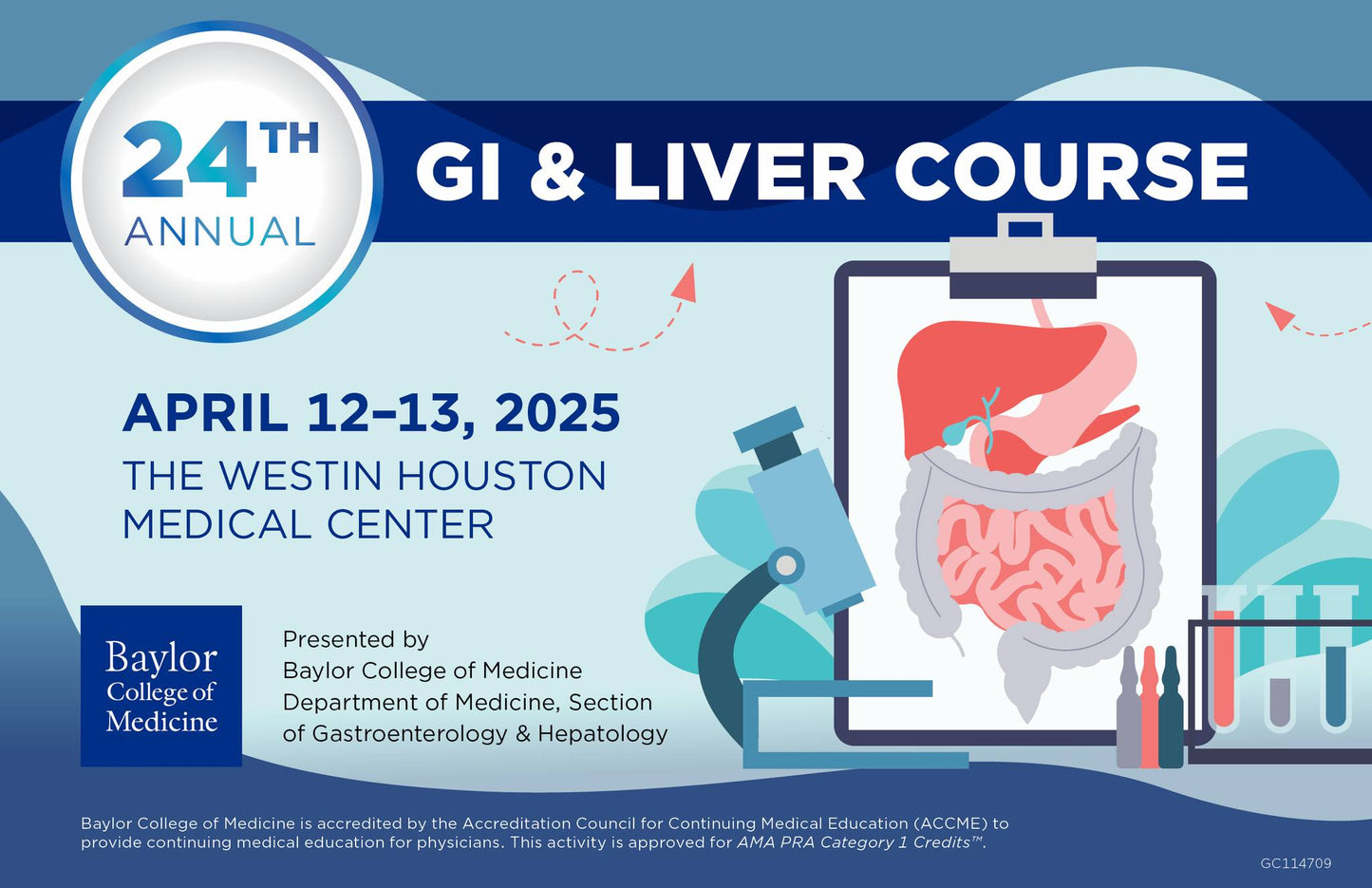
Baylor College of Medicine 24th Annual GI and Liver Course 2025
Baylor College of Medicine 24th Annual GI and Liver Course 2025
Couldn't load pickup availability

Baylor College of Medicine 24th Annual GI and Liver Course 2025
Baylor College of Medicine 24th Annual GI and Liver Course 2025
Advanced Gastroenterology & Hepatology Clinical Update CME Program
Introduction
The Baylor College of Medicine 24th Annual GI and Liver Course 2025 is a comprehensive gastroenterology and hepatology educational program designed to provide clinicians with evidence-based updates in digestive diseases, liver disorders, inflammatory bowel disease, advanced endoscopy, colorectal cancer screening, and emerging gastrointestinal therapeutics. Presented by Baylor College of Medicine, this intensive clinical course delivers practical guidance on modern diagnostic strategies, procedural innovations, and multidisciplinary management of complex gastrointestinal and hepatobiliary disorders.
Gastroenterology and hepatology continue to evolve rapidly with major advances in biologic therapies for inflammatory bowel disease, MASLD/MASH management, endoscopic resection techniques, computer-aided colonoscopy, gastrointestinal cancer screening, and liver disease therapeutics. Clinicians must continuously integrate new pharmacologic agents, updated guidelines, advanced imaging modalities, and minimally invasive procedures into daily practice.
The Baylor College of Medicine GI and Liver Course 2025 addresses these challenges through clinically focused education in:
- Gastroenterology
- Hepatology
- Inflammatory bowel disease (IBD)
- Irritable bowel syndrome (IBS)
- MASLD/MASH
- Chronic liver disease
- Colorectal cancer screening
- Advanced endoscopy
- Barrett’s esophagus
- Endoscopic mucosal resection (EMR)
- Intestinal ultrasound
- Endoscopic ultrasound (EUS)
- GI oncology
- Opioid use disorder in GI practice
The curriculum combines expert-led lectures, procedural demonstrations, clinical case discussions, and evidence-based therapeutic updates relevant to both specialty and primary care practice.
You will find this course at medicalamboss.com
Course Overview
📚 Program: Baylor College of Medicine 24th Annual GI and Liver Course 2025
🏛️ Presented by: Baylor College of Medicine
📅 Course Dates: April 12–13, 2025
📍 Location: Houston, Texas, USA
🎥 Included Content
- 27 Video Lectures
- 27 Subtitle Files (.vtt)
- 28 PDF Files
💾 Total Size: 8.79 GB
🎯 Educational Focus
- Gastroenterology
- Hepatology
- Inflammatory bowel disease
- Liver disease
- Advanced endoscopy
- GI oncology
- Colorectal cancer screening
- Barrett’s esophagus
- Intestinal ultrasound
- Procedural innovation
👨⚕️ Target Audience
- Gastroenterologists
- Hepatologists
- Internists
- Primary care physicians
- GI fellows
- Nurse practitioners
- Physician assistants
- Gastroenterology trainees
- Medical students
Educational Focus
This advanced gastroenterology course delivers clinically relevant education in:
- Digestive diseases
- Liver disorders
- Endoscopic innovation
- Colorectal cancer prevention
- Biologic therapies
- GI imaging
- Functional gastrointestinal disorders
- Multidisciplinary GI management
The curriculum emphasizes practical implementation of modern gastroenterology and hepatology strategies.
Inflammatory Bowel Disease (IBD)
A major component of the course focuses on contemporary IBD management.
Topics Include
- Biologic therapies
- Biomarkers in IBD
- Pregnancy management in IBD
- Treatment failure strategies
- Intestinal ultrasound
- Personalized IBD treatment
Participants review practical approaches to complex inflammatory bowel disease management.
Hepatology & Chronic Liver Disease
Dedicated sessions provide advanced updates in liver disease diagnosis and treatment.
Covered Areas
- MASLD/MASH
- Primary biliary cholangitis (PBC)
- Chronic liver disease
- Fatty liver disease
- Liver fibrosis assessment
- Emerging hepatology therapies
The curriculum emphasizes evidence-based approaches to modern hepatology care.
Irritable Bowel Syndrome & Functional GI Disorders
Specialized lectures address common outpatient gastroenterology disorders.
Educational Topics
- Irritable bowel syndrome (IBS)
- Chronic constipation
- Functional bowel disorders
- Gut-brain interaction
- Symptom-directed therapy
- Long-term GI management
Participants strengthen understanding of functional GI disease treatment strategies.
Advanced Endoscopy & Procedural Innovation
The course strongly emphasizes modern endoscopic techniques and technology.
Included Areas
- Computer-aided colonoscopy
- PEG tube placement
- Endoscopic submucosal dissection (ESD)
- Cold EMR
- Luminal stricture dilation
- Barrett’s ablation
- Endoscopic ultrasound (EUS)
These sessions reinforce advanced therapeutic endoscopy and procedural decision-making.
Colorectal Cancer Screening & GI Oncology
Advanced discussions focus on colorectal cancer prevention and diagnosis.
Topics Covered
- Colorectal cancer screening
- FIT DNA testing
- Cologuard
- Endoscopic cancer evaluation
- Non-invasive diagnostics
- GI malignancy management
The curriculum highlights modern screening technologies and oncology-focused GI care.
Opioid Use Disorder & Ethical Challenges in GI Care
The program also addresses addiction medicine and ethical considerations.
Educational Themes
- Opioid misuse in GI patients
- Pain management strategies
- Ethical barriers to care
- Multidisciplinary treatment approaches
- Substance use disorder management
Participants gain insight into complex behavioral and ethical issues affecting GI practice.
Learning Objectives
Upon completion of this activity, participants should be able to:
- Outline new therapies and treatment strategies for inflammatory bowel disease
- Review advances in IBS, constipation, PBC, and MASLD/MASH management
- Discuss procedural innovations in advanced endoscopy
- Summarize modern strategies for colorectal cancer diagnosis and screening
- Recognize and manage opioid misuse in patients with GI disease
- Apply evidence-based approaches to gastroenterology and hepatology practice
Learning Experience
The course combines:
- Gastroenterology
- Hepatology
- Advanced endoscopy
- GI oncology
- Liver disease
- Functional GI disorders
- Inflammatory bowel disease
- Diagnostic imaging
- Procedural medicine
- Case-based learning
The educational structure emphasizes practical clinical application and multidisciplinary digestive disease management.
Who Should Enroll
This course is especially valuable for:
- Gastroenterologists
- Hepatologists
- Internists
- Primary care physicians
- GI fellows
- Advanced practice providers
- Gastroenterology trainees
- Medical students
It is particularly useful for clinicians seeking updated guidance in digestive diseases, liver disorders, and advanced endoscopic practice.
Why This Course Stands Out
Comprehensive GI & Liver Coverage
Provides broad updates across gastroenterology, hepatology, oncology, and procedural endoscopy.
Strong Procedural Focus
Includes advanced endoscopic techniques and emerging procedural technologies.
Contemporary IBD & MASLD Education
Covers rapidly evolving therapeutic areas with major clinical relevance.
Integration of GI Oncology & Screening
Highlights colorectal cancer prevention and advanced diagnostic approaches.
Baylor Expert Faculty
Features multidisciplinary teaching from experienced gastroenterology and hepatology specialists.
Clinical Value
The Baylor College of Medicine 24th Annual GI and Liver Course 2025 delivers advanced digestive disease education through integrated coverage of:
- Inflammatory bowel disease
- Hepatology
- MASLD/MASH
- Irritable bowel syndrome
- Advanced endoscopy
- Barrett’s esophagus
- Endoscopic ultrasound
- Colorectal cancer screening
- GI oncology
- Functional bowel disorders
- Procedural gastroenterology
- Opioid-related GI care
The combination of evidence-based clinical updates, procedural innovation, advanced liver disease management, and multidisciplinary gastroenterology education makes this course highly valuable for modern digestive disease practice.
4. Topics
-
The Future of Gastroenterology – What’s on the Horizon
-
Primary Biliary Cholangitis – A Whole New Terrain
-
The Encroachment of GLP-1 How it Affects the Practice of Gastroenterology
-
Defining MetALD and Its Treatment Approach
-
Novel Treatment for Antibiotic Resistant Clostridioides difficile
-
Addressing Pouchitis – From Inpatient to Outpatient
-
When One Biologic Fails
-
Help! My IBD patient Has a New Diagnosis – Pregnancy and Malignancy
-
Nuances of Perianal Disease
-
Colon cancer – Screening, diagnosis, and beyond
-
Gastroesophageal reflux disease
-
Incorporating the Endoscopic treatment of Obesity Guidelines into your practice
-
Computer-Aided-Detection Assisted Colonoscopy – Applying the AGA guidance
-
ACG Guidance on H pylori – Taking a Critical Approach
-
The Old PEG tube – New Approach and the ASGE Guidelines
-
ACG Clinical Guideline Focal Liver Lesions
-
Hot off the Press! Diagnosis and Management of Eosinophilic Esophagitis
-
Chasing a Polyp Down the Rabbit Hole – Endoscopic Appendectomy
-
Getting Through the Luminal Squeeze – Stricture Dilations and Beyond
-
Esophageal Diverticula and Cricopharyngeal Disease – Beyond the Zenker
-
Pneumatic Balloon Dilation – Does It Still Have a Role in My Practice
-
Cold EMR
-
Barrett’s ablation
-
Hemorrhoid Banding
-
Endoscopic vacuum therapy
-
BCM IMAGINE Program – Genetic Influence on Disease and Health
-
Managing Pain and Opioid Misuse Disorder for the Gastroenterologist